
No products in the cart.
Troy Ounces, Grams, and Kilograms in Bullion

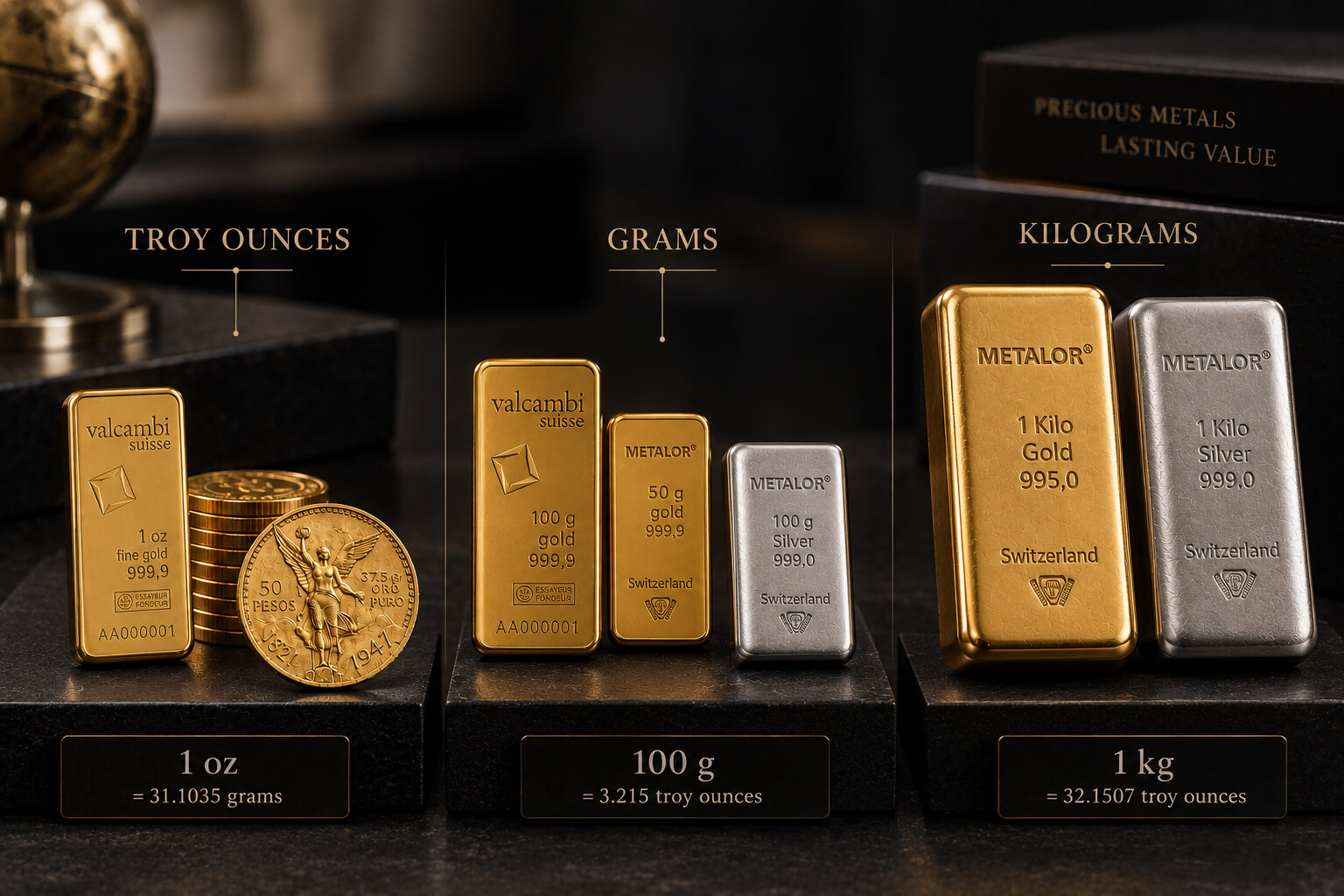
Physical bullion is sold in several weight formats.
A buyer might see a five-gram gold bar, a 20-gram bar, a one-ounce product, a 100-gram bar, or a one-kilogram silver bar during the same shopping session.
For someone new to precious metals, switching between these measurements can make comparison feel more complicated than it needs to be.
The underlying idea is simple: each measurement describes how much physical metal the product contains.
What changes is the unit being used.
Understanding grams, troy ounces, and kilograms helps buyers compare physical bullion more accurately, understand product names, and avoid relying on visual size alone.
Grams Are Common Across Gold Bars
Gram-denominated gold bars make it easy to see how different products relate to one another.
Common examples can include:
- 5 grams
- 10 grams
- 20 grams
- 50 grams
- 100 grams
- 500 grams
If one product contains 20 grams of gold and another contains 50 grams, the second contains two and a half times as much gold by weight.
The calculation is straightforward because both products use the same measurement system.
This is one reason gram-based bullion can feel intuitive.
A buyer can compare several bars without converting between units.
The Troy Ounce Is Different From the Everyday Ounce
Precious metals commonly use the troy ounce.
One troy ounce equals approximately 31.1035 grams.
This is important because the troy ounce is not the same as the standard ounce commonly used for food and other everyday goods.
A standard avoirdupois ounce is approximately 28.35 grams.
The difference may seem small, but it matters when discussing precious metals.
When a bullion product is described as a 1 oz gold bar, the industry normally means one troy ounce.
That represents approximately 31.1035 grams of metal.
Why the Troy Ounce Appears So Often
International precious-metal markets commonly quote gold and silver prices per troy ounce.
This makes the measurement particularly familiar in bullion trading.
A buyer following international gold prices may therefore see a market price expressed per ounce and then encounter physical products such as the 1 oz Valcambi Swiss Gold Bar.
The format creates a direct connection between the physical product and the unit commonly used in the broader market.
However, buyers do not need to purchase one-ounce products simply because international pricing uses ounces.
Gram-denominated bullion remains equally understandable when the conversion is known.
Converting Troy Ounces Into Grams
The basic relationship is:
1 troy ounce ≈ 31.1035 grams
This means a one-ounce bar contains slightly more than 31 grams of metal.
For practical comparison, buyers can remember that one troy ounce is approximately 31.1 grams.
That makes it easier to compare a one-ounce product with nearby gram-denominated options.
For example:
- 20g is less than one troy ounce
- 31.1035g is approximately one troy ounce
- 50g is more than one troy ounce
- 100g is slightly more than three troy ounces
The exact conversion becomes more important when making precise calculations.
For normal product comparison, understanding the general relationship is often enough.
Kilograms Are Common in Larger Bullion Formats
One kilogram equals 1,000 grams.
Kilogram products are particularly common in physical silver because silver has a much lower market value per gram than gold.
A 1kg silver bar therefore represents a substantial physical object while remaining within a purchase range that can be practical for bullion buyers.
RM Bullion offers products such as the 1 Kg Valcambi Swiss Silver Bar and 1 Kg Metalor Swiss Silver Bar.
A kilogram format provides:
- 1,000 grams of total weight
- A single large physical unit
- Substantial physical presence
- Different storage requirements from small gold bars
The size makes kilogram bars easy to distinguish physically from smaller bullion products.
One Kilogram Is About 32.15 Troy Ounces
A kilogram can also be expressed in troy ounces.
Because one troy ounce is approximately 31.1035 grams:
1 kilogram ≈ 32.15 troy ounces
This conversion is useful when silver prices are being quoted per ounce but the physical product is sold as a one-kilogram bar.
The buyer can understand how the international pricing unit relates to the physical product.
Again, that does not mean the retail product price will equal the simple spot-price calculation exactly.
Physical bullion can also include premiums and other transaction considerations.
Do Not Compare Products by Visual Size
Measurement becomes particularly useful because photographs can distort perception.
A five-gram gold bar may be photographed closely enough that it fills an entire product image.
A one-ounce gold bar may be displayed in another image at nearly the same visual size.
Without a shared scale, the photographs can appear surprisingly similar.
The written weight removes that ambiguity.
When comparing physical bullion, prioritize:
- Metal
- Weight
- Purity
- Refinery
- Dimensions
- Product format
Appearance comes after those specifications.
Gold Concentrates More Value Into Smaller Weight
Gold and silver use the same weight measurements, but the monetary value associated with those weights is very different.
One kilogram of gold represents a dramatically different value from one kilogram of silver.
This is why gold bullion often appears in smaller physical denominations.
A relatively compact gold bar can represent a meaningful amount of value.
Silver ownership commonly involves more physical weight.
This difference influences:
- Product sizes
- Storage
- Transport
- Budget planning
- Number of pieces
The unit of measurement remains the same.
The metal value changes.
Weight Is Different From Purity
Another important distinction is the difference between weight and purity.
Weight tells you how much the product weighs.
Purity tells you the fineness of the precious metal.
A gold bar marked 999.9 represents highly refined gold.
When reviewing bullion, both specifications matter.
A buyer should not assume that a large product automatically has higher purity.
Likewise, a small product can have the same fineness as a much larger one.
Weight and purity answer different questions.
Product Names Often Tell You the Main Specifications
Bullion product names are usually practical.
For example:
20 Gram Valcambi Swiss Gold Bar
The name already communicates several important facts:
- Weight: 20 grams
- Refinery: Valcambi
- Origin description: Swiss
- Metal: gold
- Format: bar
A product such as a 1 oz Metalor Swiss Gold Bar communicates the same categories using a troy-ounce weight.
Once buyers understand the measurements, product names become much easier to read.
Different Units Do Not Mean Different Quality
A one-ounce bar is not automatically better than a 20-gram bar because it uses ounces.
A 100-gram bar is not automatically superior because it is heavier.
The weight should match the buyer’s needs.
Smaller denominations may offer greater flexibility.
Larger denominations can concentrate more metal into fewer physical products.
The right choice depends on:
- Budget
- Desired flexibility
- Storage
- Buying frequency
- Long-term plan
Measurement helps define the product.
It does not determine whether that product is right for every buyer.
Smaller Units Can Support Gradual Accumulation
A buyer who prefers to acquire bullion gradually may find smaller gram-denominated bars easier to integrate into a recurring purchase plan.
Instead of waiting until the budget supports a much larger product, the buyer can acquire smaller physical units over time.
This approach can also create several individually manageable pieces.
The trade-off is that smaller products may carry a different premium structure relative to their gold content.
The decision should therefore consider both flexibility and total cost.
Larger Units Can Simplify Organization
Larger bars reduce the number of individual products required to hold a particular amount of metal.
For example, one 100-gram bar is one physical item.
Five 20-gram bars represent the same total nominal weight across five individual products.
The ownership experience differs.
Fewer larger pieces can simplify inventory.
Several smaller pieces can provide more divisibility.
Neither approach is universally correct.
Weight Influences Storage Planning
A collection of small gold bars can remain physically compact.
A large silver allocation can require substantially more space.
This is where kilograms and total collection weight become important.
Someone accumulating silver regularly should consider not only the value of the products but also:
- Total physical weight
- Storage capacity
- Shelf or safe load
- Product organization
- Accessibility
One kilogram may be easy to store.
Several dozen one-kilogram bars create a very different physical requirement.
Weight Also Influences Transport
Bullion ownership may eventually involve moving products into storage, collecting purchases, or presenting bullion for resale.
The physical weight matters.
Gold remains relatively compact.
Large silver holdings become noticeably heavier.
Safe transport should account for:
- Product protection
- Total load
- Discretion
- Packaging
- Secure handling
This practical difference is easy to underestimate when bullion is viewed only through an online product page.
Use One Unit When Comparing
When comparing products closely, it can help to convert them into the same unit.
For example, compare all nearby gold products in grams.
A one-ounce bar becomes approximately 31.1035 grams.
Then compare:
- 20g
- 31.1035g
- 50g
The relationship becomes immediately clearer.
The same method can be used when comparing larger silver weights.
The Measurement Should Serve the Buying Plan
Buyers do not need to prefer grams, ounces, or kilograms as a matter of principle.
Each unit is simply a way of describing weight.
The more important question is what physical format works for the buyer’s purpose.
Someone may prefer gram bars because they create straightforward incremental steps.
Another buyer may like the internationally familiar one-ounce format.
A silver buyer may prefer kilograms because they create a convenient large-bar denomination.
All can be valid.
Understanding the Units Makes Bullion Simpler
Precious-metal terminology can initially make bullion appear more technical than it really is.
Once the main measurements are understood, the structure becomes clear:
- Gram: metric weight unit commonly used for gold bars
- Troy ounce: traditional precious-metals measurement equal to about 31.1035g
- Kilogram: 1,000 grams, commonly seen in larger silver formats
These units describe physical quantity.
They help buyers compare products, understand market references and plan physical ownership more accurately.
A bullion product does not become complicated because it uses a different unit.
The buyer simply needs to know how the units relate.
Frequently Asked Questions
How many grams are in one troy ounce of gold?
One troy ounce equals approximately 31.1035 grams.
Is a troy ounce the same as a normal ounce?
No. A troy ounce is approximately 31.1035 grams, while a standard avoirdupois ounce is approximately 28.35 grams.
How many grams are in one kilogram?
One kilogram equals 1,000 grams.
Why are silver bars often sold in kilograms?
Silver has a lower value per unit of weight than gold, so larger physical formats such as one-kilogram bars are common.
Is a one-ounce gold bar better than a gram-denominated bar?
Not automatically. The best format depends on budget, storage, flexibility and the buyer’s intended approach.
Compare Bullion Weights With Clarity
Explore gold and silver products across grams, ounces, and kilogram formats from recognized Swiss refineries.
Related Articles
Before Selling Physical Bullion
Buying physical bullion is often discussed in terms of selecting the right product, choosing a weight,...
Read More
Gold Bars and Gold Coins Serve Different Buying Goals
Gold bars and gold coins are two of the most recognized ways to own physical gold....
Read More
What Determines the Price of Physical Bullion?
A physical gold bar can have one price in the morning and a different price later....
Read More