
No products in the cart.
Understanding Bullion Premiums Before You Buy

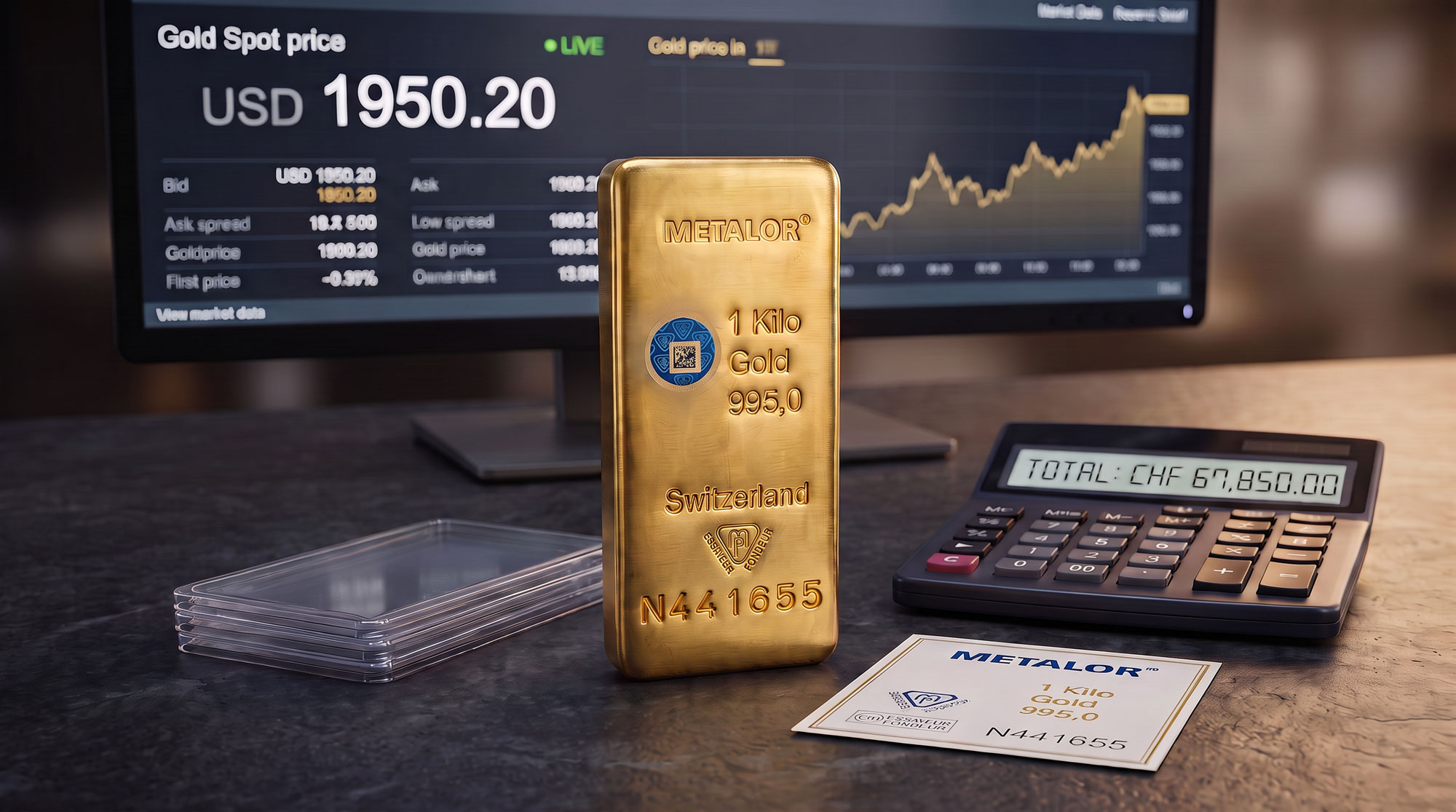
When buyers look at the price of a gold bar or silver bar, one of the first questions they may have is why the amount they pay is different from the metal price they see quoted in financial markets.
The difference is important to understand because buying physical bullion involves more than purchasing an abstract quantity of gold or silver.
A physical bar must be refined, manufactured, tested, packaged, transported, distributed, securely handled and ultimately made available to the buyer. Those elements contribute to what is commonly described as the bullion premium.
Understanding premiums can make product comparisons more useful. Instead of looking only for the lowest number, buyers can evaluate what they are purchasing, how much precious metal the product contains, who produced it, what format it comes in and whether it fits their intended approach.
RM Bullion offers physical gold and silver from recognized Swiss refineries, including products from Valcambi and Metalor. Its current range includes gold bars, gold coins and silver bars in different sizes and formats.
What Is a Bullion Premium?
The market price of gold or silver provides a reference for the value of the underlying precious metal.
A physical bullion product, however, usually trades above that underlying reference price when purchased.
That difference is commonly called the premium.
A simple way to think about it is:
Physical bullion price = metal value + premium
The premium can reflect several components involved in turning refined precious metal into a finished investment product and bringing that product to market.
These may include refining, manufacturing, minting, certification, packaging, transportation, insurance, distribution, inventory and dealer-related costs.
Premiums are therefore not necessarily identical across every product containing the same amount of metal.
Why Product Format Matters
Two products can contain the same precious metal while having different manufacturing requirements.
A large cast bar and a small minted bar are not produced in exactly the same way. A detailed bullion coin is different again.
Smaller products often require more manufacturing, packaging and handling relative to the amount of metal they contain.
Consider a buyer allocating the same total amount of gold through many small bars versus one larger bar.
The smaller bars require multiple individual products to be manufactured and handled. Each piece may have its own markings and packaging.
The larger bar concentrates more gold into a single unit.
This helps explain why comparing premiums only in absolute monetary terms can be misleading.
Compare Premiums Relative to Metal Content
Suppose two bars have different total premiums.
The larger product may have the higher premium in dollars because it contains substantially more gold, while having a lower premium relative to the value of the metal inside it.
Buyers can therefore consider both:
- The total amount paid above the underlying metal value
- The premium as a percentage of that metal value
Looking at both provides a clearer comparison.
Smaller Gold Bars Offer a Different Trade-Off
Small gold bars can be attractive because they allow buyers to acquire physical gold in more manageable individual units.
A buyer may prefer a 5g, 10g or 20g bar because it fits their budget or because several smaller units provide greater flexibility.
RM Bullion, for example, lists a 20 Gram Valcambi Swiss Gold Bar with 999.9 fineness. The format is compact and represents 20 grams of fine gold from a recognized Swiss refinery.
The trade-off is that smaller bars can carry a different premium structure than larger formats.
This does not make a smaller bar a poor choice.
It means the buyer is receiving something in exchange for that difference: a smaller individual unit.
The right question is therefore not simply, “Which product has the lowest premium?”
It is, “Which combination of premium, weight and flexibility fits what I am trying to accomplish?”
Larger Bars Can Concentrate More Metal Per Product
Larger gold bars can appeal to buyers who want to concentrate a greater amount of gold into fewer physical pieces.
For example, RM Bullion lists a 50 Gram Valcambi Swiss Gold Bar with a stated fineness of 999.9.
It also carries larger formats such as a 500 Gram Valcambi Swiss Gold Bar.
A larger bar may involve fewer individual products for the same total gold allocation.
That can affect storage, organization and the premium paid relative to the quantity of metal.
However, larger is not automatically better.
A buyer who owns one large bar cannot divide that physical bar into several smaller transactions without changing the product itself.
Someone who values flexibility may deliberately accept the premium structure associated with smaller denominations.
Refinery Recognition Can Matter
Bullion is not simply anonymous metal.
Recognizable refiners provide standardized products with established specifications, markings and reputations.
RM Bullion states that it focuses on Swiss-certified precious metals sourced from internationally accredited Swiss refineries. Its current product range includes brands such as Valcambi and Metalor.
Recognized refinery products can make identification more straightforward because buyers can review information such as:
- Manufacturer
- Weight
- Fineness
- Product dimensions
- Refinery markings
- Packaging where applicable
This recognition can form part of the overall value proposition surrounding a physical bullion product.
A premium comparison should therefore consider the actual product rather than treating every bar of the same weight as interchangeable without further inspection.
Gold Coins Have Their Own Premium Dynamics
Gold coins introduce another category.
A bullion or investment-oriented coin may carry manufacturing, minting and distribution considerations that differ from a simple bar.
Some coins also have historical recognition, distinctive designs or particular market demand.
This means a buyer comparing a gold bar and a gold coin of similar metal content should not expect their prices to be structured identically.
The decision depends on what the buyer wants.
Someone prioritizing a straightforward bar format may prefer bars.
Someone who values the established form and character of a recognized gold coin may consider the additional characteristics worthwhile.
Neither choice should be made solely from the premium number without considering the product itself.
Silver Premiums Deserve the Same Attention
The same principle applies to silver.
Because silver has a lower value per unit of weight than gold, manufacturing and distribution costs can represent a more noticeable proportion of the final product price.
That makes product size especially relevant.
RM Bullion currently lists silver bars including a 250 Gram Metalor Swiss Silver Bar with stated 999 fineness.
Its broader selection also includes 1kg Valcambi and Metalor silver bars.
A buyer deciding between several smaller silver bars and a larger bar can therefore compare not only total cost, but also flexibility, storage and the effective premium relative to the amount of silver acquired.
Supply and Demand Can Affect Premiums
Premiums are not necessarily fixed forever.
Physical bullion exists within a real supply chain.
When demand for a particular product rises rapidly, available inventory may become tighter.
Manufacturers and distributors cannot always increase the supply of finished physical products instantly.
Even if raw gold or silver is available, it still needs to move through refining, fabrication, packaging and distribution.
Periods of unusually strong retail demand can therefore create situations where physical product premiums move differently from the underlying metal price.
The reverse can also occur when availability improves or demand becomes less intense.
This is one reason buyers should distinguish between the international metal price and the price of a specific physical product.
Availability Can Be Part of the Decision
A product with an attractive theoretical premium is not useful if it cannot actually be purchased when the buyer wants it.
Availability matters.
A disciplined comparison therefore includes:
- Current product availability
- Weight and purity
- Refinery or mint
- Total purchase price
- Premium relative to metal content
- Intended holding period
- Future flexibility
These factors provide more context than simply sorting products by price.
The Lowest Premium Is Not Always the Best Fit
It can be tempting to assume that the lowest premium always represents the smartest purchase.
That conclusion overlooks the buyer’s individual needs.
Imagine two buyers.
The first wants to allocate a substantial amount to gold and expects to keep it in secure storage for a long period without needing to divide it.
The second wants several individually manageable pieces and values the ability to sell or transfer only part of the holding.
The first buyer may prefer larger bars.
The second may prefer smaller bars despite a potentially different premium structure.
Both can make rational decisions because they are optimizing for different goals.
Premiums Should Be Considered Before Resale Too
The purchase is only one side of a bullion transaction.
Buyers should also think about eventual resale.
The price at which a dealer buys bullion back will not necessarily equal the price at which the same product is sold to a customer.
This difference is often described through the buy-sell spread.
Understanding both premiums and spreads provides a more complete picture of transaction economics.
A buyer focused only on the purchase price may miss this broader context.
Before choosing a product, consider whether it is a recognized format, whether there is an established market for it and how easily it can be evaluated later.
Build Comparisons Around Equivalent Products
Good comparisons need to be fair.
Comparing a 5g minted gold bar with a 1kg silver bar tells you very little about relative premiums because they represent different metals, weights and product structures.
Instead, compare products within relevant categories.
For gold bars, consider similar weights from recognized refiners.
For silver, compare equivalent or nearby sizes.
For coins, consider the actual metal content, mint, recognition and product type.
This reduces the chance of drawing conclusions from numbers that are not truly comparable.
Transparent Pricing Supports Better Decisions
The purpose of understanding premiums is not to make bullion buying complicated.
It is the opposite.
Once buyers understand why the physical product price can differ from the underlying metal reference, they can compare options more confidently.
RM Bullion emphasizes transparent pricing, certified bullion stock and access to recognized Swiss-refinery products.
A buyer can then focus on the practical questions:
How much metal am I acquiring?
What product am I receiving?
Is the refinery recognized?
Does the weight suit my budget?
Does the format give me the flexibility I want?
Does the total transaction make sense for my objectives?
Premiums Are Part of Physical Ownership
A bullion premium exists because physical bullion is a finished, deliverable product.
It has been refined, manufactured, identified, handled and made available for ownership.
Understanding that distinction can help buyers move beyond the misconception that every amount above the market metal price is arbitrary.
The goal should not be to ignore premiums.
Nor should it be to chase the lowest premium without considering anything else.
The goal is to understand what you are paying for and choose deliberately.
When weight, product type, refinery recognition, availability, flexibility and total transaction costs are considered together, bullion comparisons become much more meaningful.
Frequently Asked Questions
What is a bullion premium?
A bullion premium is the amount paid above the underlying value of the precious metal. It can reflect manufacturing, refining, packaging, distribution, inventory and other costs associated with providing a finished physical product.
Why can smaller gold bars have different premiums?
Smaller bars require individual manufacturing, handling and often packaging for each unit, so those costs can represent a greater proportion of the metal value.
Does a higher premium mean a bullion product is better?
Not necessarily. Premiums should be evaluated alongside weight, refinery, product type, availability, flexibility and the buyer’s objectives.
Do silver bars have premiums too?
Yes. Physical silver products also trade at prices that can differ from the underlying silver value, with product weight and manufacturing format influencing the difference.
Should I always buy the bullion product with the lowest premium?
No. A lower premium may be attractive, but the product should also suit your budget, storage needs, desired flexibility and long-term plans.
Compare Bullion with Greater Clarity
Explore gold bars, gold coins, and silver bars across different weights and recognized Swiss refineries.
Related Articles
Bullion Buying Should Match Your Purpose
Buying bullion becomes easier when the buyer understands the reason behind the purchase. Gold bars, gold...
Read More
Physical Bullion Gives Buyers a Sense of Control
Physical bullion gives buyers something that many modern assets cannot offer: direct ownership. A gold bar,...
Read More
A Practical Guide to Bullion Liquidity
When people describe physical bullion, they often focus on weight, purity, refinery and price. Another term...
Read More